
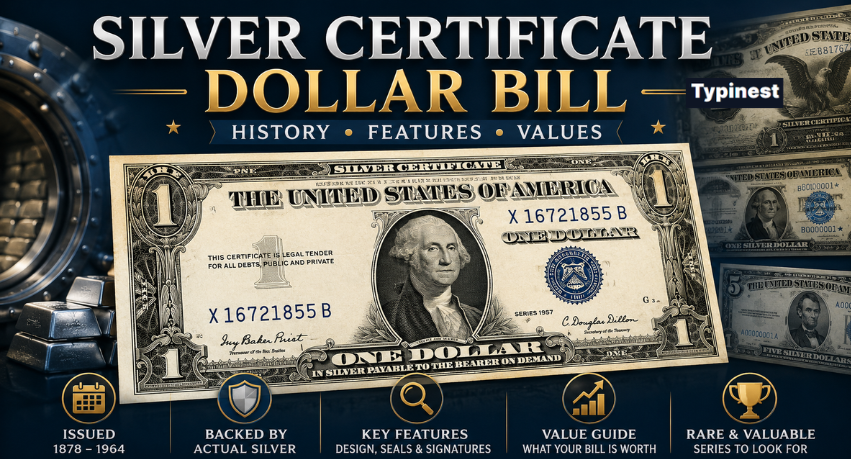
Have you ever stumbled across an old dollar bill with a blue seal instead of the usual green one and wondered what it’s worth? You’re not alone. Silver certificate dollar bills are one of the most collected and misunderstood pieces of American currency history, and they’re hiding in more sock drawers and attic boxes than you’d think.
Whether you inherited a Silver Certificate from a family member, found one in an old collection, or are just beginning to explore paper money collecting, understanding its value can be both exciting and rewarding. A note’s series date, blue Treasury seal, signature combination, condition, serial number, and rarity all influence its desirability in the collector market.
This guide breaks down everything: series dates, what that blue seal means, whose signatures matter, and what your silver certificate might fetch on today’s market.
Silver Certificate Dollar Bill Facts, Features, and Value Guide
| Feature | Details |
|---|---|
| Definition | A Silver Certificate Dollar Bill was backed by silver held by the U.S. Treasury. |
| First Issue | 1878 |
| Final Issue | 1964 |
| Seal Color | Blue Treasury Seal |
| Most Common Denomination | $1 |
| Redeemable for Silver Until | 1968 |
| Popular Series | 1899, 1923, 1935, 1957, 1963 |
| Most Common Note | 1957 $1 Silver Certificate |
| Rare Large-Size Note | 1899 Black Eagle Certificate |
| Famous Collectible | 1896 Educational Series Note |
| Common Circulated Value | $1.25–$3.50 |
| Common Uncirculated Value | $12–$25 |
| Star Note Value (Circulated) | $5–$30 |
| Star Note Value (Uncirculated) | $30–$100+ |
| 1899 Black Eagle Value | $50–$150+ |
| 1896 Educational Value | $200–$600+ |
| 1923 Large-Size Value | $40–$100 |
| 1934 $5 Certificate Value | $8–$20 |
| 1934 $10 Certificate Value | $15–$40 |
| Key Value Factor | Condition |
| Valuable Feature | Star Serial Number |
| Rare Feature | Printing Errors |
| Signature Importance | Certain signature combinations are scarcer than others. |
| Collector Demand | High for rare and well-preserved notes. |
| Investment Potential | Rare Silver Certificate Dollar Bills can appreciate over time. |
What Is a Silver Certificate Dollar Bill?
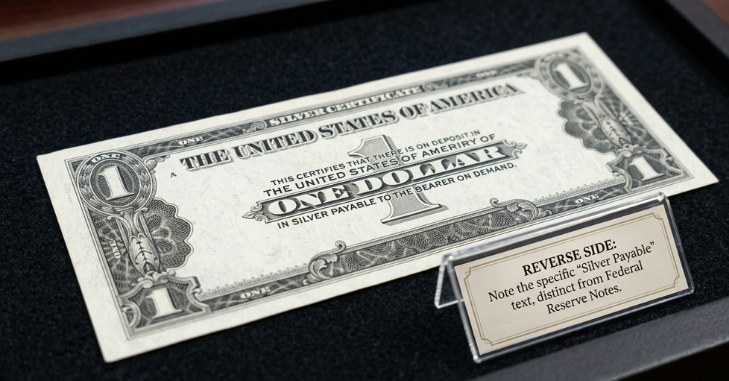
The U.S. government issued silver certificate dollar bills from 1878 to 1964 and backed them with actual silver reserves held in the U.S. Treasury. Unlike modern Federal Reserve Notes, these certificates could be redeemed for an equivalent amount of silver.
The U.S. government officially retired Silver Certificates on June 24, 1968. After that date, holders could no longer redeem these notes for silver. Today, they remain legal tender but are worth face value at a minimum, and often much more. The most iconic feature? That distinctive blue seal is on the right side of the bill.
The Blue Seal: What It Means and Why It Matters.
Understanding the Treasury Seal
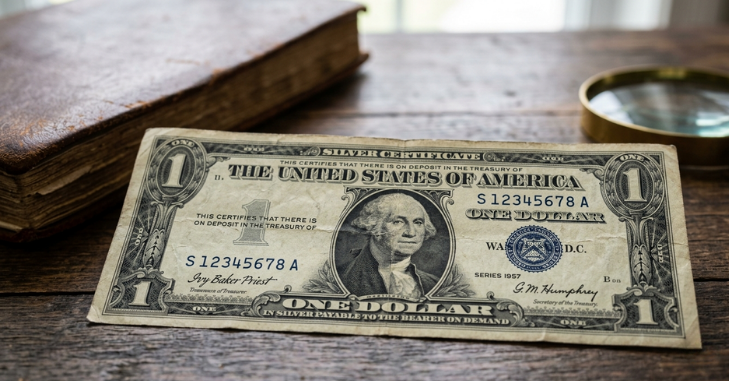
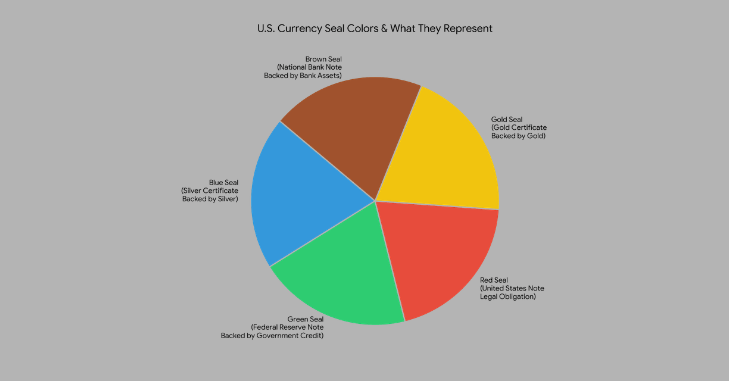
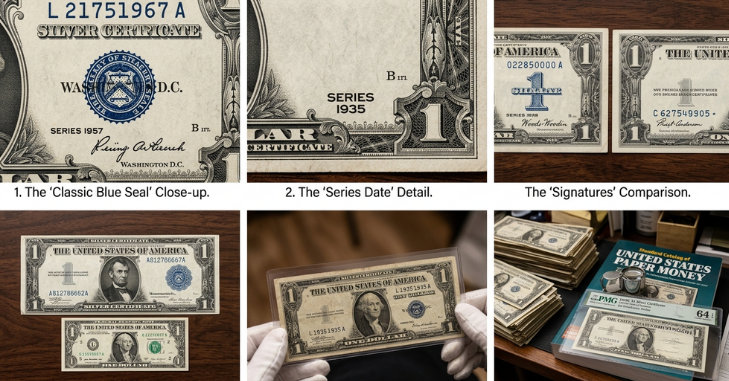
Every silver certificate carries a blue Treasury seal; this is the single most recognizable identifier. On modern bills, you’ll see a green seal (Federal Reserve Notes) or a red seal (United States Notes). Blue = Silver Certificate. Every time.
The blue seal signifies:
- The bill was issued by the U.S. Treasury (not a Federal Reserve Bank)
- It was originally backed by silver bullion.
- It is a distinct monetary class from other U.S. currency types.
Blue Seal vs. Other Seal Colors
Series Dates Explained
What Does the Series Date Actually Mean?
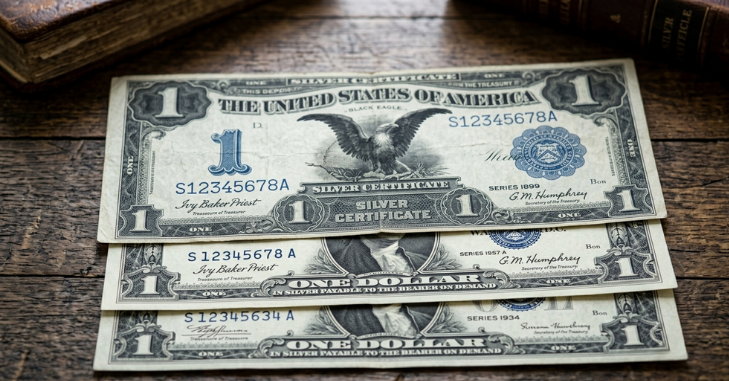
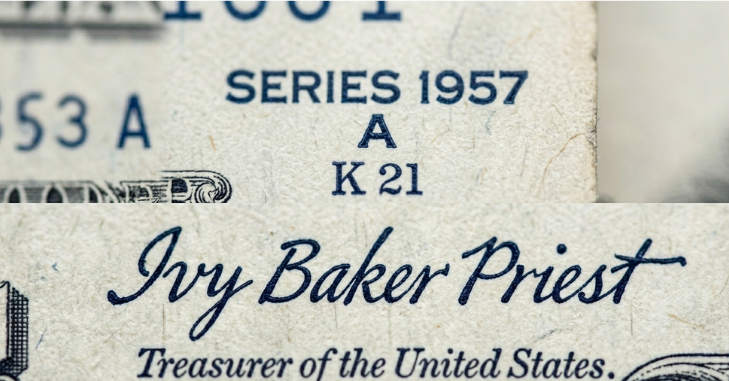
Many collectors misunderstand series dates on Silver Certificates. The series date does not indicate when the government printed the note. Instead, it shows when officials approved the design or introduced a new signature combination. For example, a bill labeled “Series 1957” may have remained in production and been printed as late as 1963.
Major Silver Certificate Series briefly
- 1878 Start: First notes issued.
- 1886 The First Lady: Martha Washington appears on the $1 bill.
- 1896 The Peak Art: The famous “Educational Series” drops.
- 1923 The Big Bills End: Last year of the oversized notes.
- 1928 The Shrinkage: Bills change to the modern, smaller size.
- 1934 The Flood: The most common $1 bill entered circulation.
- In 1957, the motto “In God We Trust” was added to the back.
- 1963 The End: The very last series is printed.
The Most Collected Series
- 1896 “Educational Series”: Widely considered the most artistically stunning U.S. currency ever produced. Features allegorical figures and intricate engravings. A circulated $1 example can fetch $200–$500+.
- 1899 “Black Eagle”: Named for the large eagle on the reverse. Extremely popular with collectors. Fine examples regularly sell for $50–$150.
- 1923 Large-Size $1: The last of the large-format bills. Collector demand keeps prices strong at $30–$100+ for average circulated examples.
- 1934 & 1935 Series: The most common silver certificates. Hundreds of millions were printed. Most circulated examples are worth $1.25–$5, but star notes and uncirculated examples command premiums.
- 1957 Series: First $1 silver certificate to include “In God We Trust.” Very common but still beloved by beginners.
Signature Combinations: Why They Matter?
Treasurer + Secretary of the Treasury
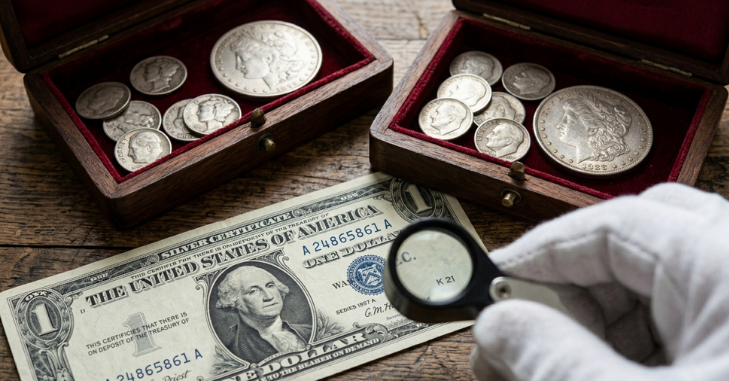
Every silver certificate carries two signatures: the U.S. Treasurer and the Secretary of the Treasury. Whenever either official changed, the U.S. Treasury added a new letter suffix to the series designation, creating versions such as 1935A, 1935B, 1935C, and later variations. This matters because rarer signature combinations = higher value.
Key Signature Combinations to Know
| Series | Treasurer | Secretary | Relative Scarcity |
| 1935A | Julian | Morgenthau | Common |
| 1935E | Priest | Humphrey | Common |
| 1935F | Priest | Anderson | Moderate |
| 1935G | Smith | Dillon | Slightly Scarce |
| 1935H | Granahan | Dillon | Scarcer |
| 1957 | Priest | Anderson | Very Common |
| 1957A | Smith | Dillon | Common |
| 1957B | Granahan | Dillon | Common |
The 1928 series has particularly valuable signature variations. The 1928B (Woods/Mellon) is the scarcest of that group and can be worth 10x more than the common 1928A.
Denominations: It’s Not Just $1 Bills
Most people only know the $1 silver certificate, but they were issued in multiple denominations:
- $1: Most common; billions printed
- $5: Blue seal, portrait of Lincoln; moderately collectible
- $10: Blue seal, portrait of Hamilton; less common
- $500 and $1,000: Extremely rare; museum-quality pieces worth tens of thousands
The $5 and $10 denominations from the 1934 series are especially popular because they’re old enough to be interesting but affordable enough for most collectors.
Market Values: What Is Your Silver Certificate Dollar Bill Worth?
The 3 Factors That Drive Value
- Condition (Grade): A crisp, uncirculated note can be worth 10–50x a heavily worn one
- Series and Signatures: Rarer combinations command serious premiums
- Serial Number: Low numbers, radar numbers, repeaters, and star notes all add value.
Current Value Ranges Market
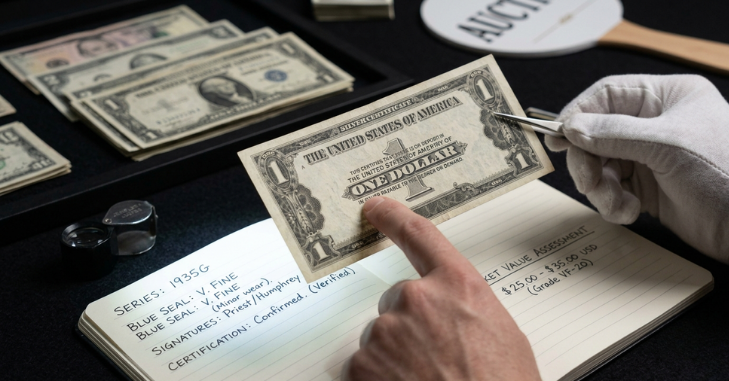
In the collector market, the value of a silver certificate dollar bill varies significantly by series, condition, and rarity. The most common 1935 and 1957 $1 Silver Certificates are worth between $1.25 and $3.50 in circulated condition and $12 to $25 in uncirculated condition.
Star Notes typically command higher premiums, ranging from $5 to $30 when circulated and $30 to $100 or more in uncirculated grades. More desirable notes, such as the 1899 Black Eagle Silver Certificate, often sell for $50 to $150 in circulated condition, while the famous 1896 Educational Series $1 note can bring $200 to $600 or more, depending on its condition.
Meanwhile, a 1923 Large-Size $1 Silver Certificate generally ranges from $40 to $100 in fine condition. Higher denominations also carry premiums, with circulated 1934 $5 Silver Certificates typically worth $8 to $20 and 1934 $10 Silver Certificates valued between $15 and $40.
What Makes a Star Note?
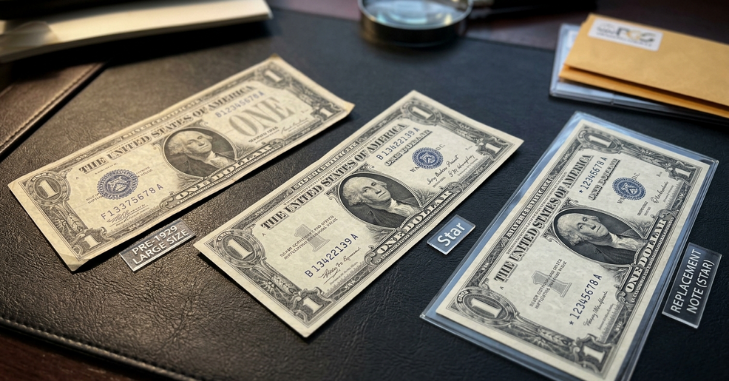
Star notes have a ★ (star) symbol at the beginning or end of the serial number. The Bureau of Engraving and Printing produced these notes to replace damaged or misprinted bills during the printing process. Because the Bureau printed fewer replacement notes, collectors typically value them higher than regular notes with standard serial numbers.
How to Check If Your Bill Is Valuable: A Step-by-Step Guide
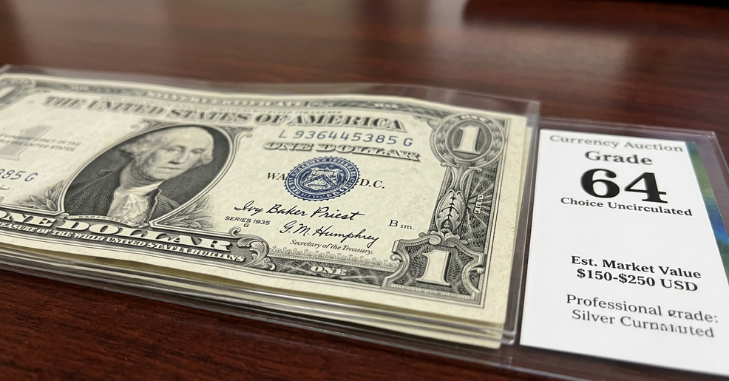
- Look at the seal color. Blue = silver certificate. Confirmed.
- Find the series date. Look near the portrait, bottom left, or right.
- Note the series of letters, if any (A, B, C, etc., after the year).
- Check the signatures. Bottom left and right of the bill.
- Examine the serial number. Stars, low numbers, or patterns (like 12345678) add premium.
- Assess the condition. Folds, tears, stains, and writing all reduce value.
- Cross-reference with a price guide like the Standard Catalog of United States Paper Money or check recent sales on eBay and Heritage Auctions.
- Consider professional grading (PCGS or PMG) for anything you think might be worth $ 50 or more.
Condition Grading: The Collector’s Cheat Sheet
| Grade | Description | Impact on Value |
| Poor (P-1) | Barely identifiable | Near face value only |
| Good (G-4) | Heavy wear, intact | Slight premium on rare notes |
| Fine (F-12) | Moderate wear, clean | Standard collectible value |
| Very Fine (VF-30) | Light wear, sharp details | Notable premium |
| Extremely Fine (EF-45) | Minimal wear | Strong premium |
| Uncirculated (MS-63+) | No wear, crisp | Maximum collector value |
Conclusion
Silver certificate dollar bills are a fascinating window into American monetary history, from the days when paper money was backed by real silver stored in a vault. Whether you’ve inherited a stack of old bills or you’re actively building a collection, understanding series dates, blue seal significance, signature combinations, and grade-based values puts you miles ahead of the average person.
Even a common 1957 series $1 silver certificate is a piece of tangible history that has outlasted the silver standard itself. And if you do happen to find a star note, an early series, or a bill in pristine uncirculated condition, you might be holding something genuinely special. Never pay a blue seal bill before checking its value.
Apart from that, if you want to know more about Maurices Credit Card: All You Need to Know About Key Features & Benefits, Fees & Interest Rates, Eligibility & Approval Requirements, And Much More then visit our Finance category.
Frequently Asked Questions (FAQs)
Yes. Silver certificates are still legal tender and are accepted at face value for $1, $5, or $10 denominations. However, spending a collectible note is almost always a bad financial decision if it’s worth more than its face value.
No. Redemption privileges ended on June 24, 1968. Today, they’re collectibles only.
In almost every case, yes, at a minimum of a small amount. Commonly circulated examples are worth $1.25–$3.50, while rarer varieties can be worth thousands of dollars. The key is knowing which one you have.
In everyday circulation, a star note from the 1935G or 1935H series in uncirculated condition could fetch $75–$200+. True rarities, such as the 1896 Educational Series or large-denomination bills, require auction houses to sell properly.
If you believe it’s worth $50 or more, professional grading by PMG (Paper Money Guaranty) or PCGS Currency is worth the investment. Graded notes sell significantly more, and buyers trust them more in auctions.